
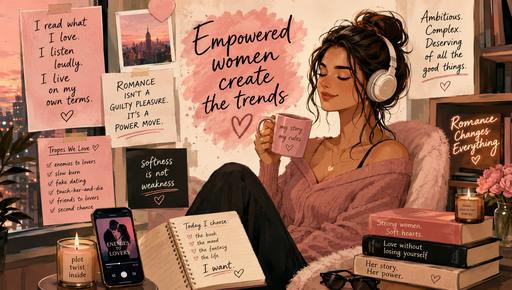
Empowered Women Create the Trends
For a long time, women were taught to edit themselves. To make their tastes smaller, cooler, more acceptable. To say they liked the “right” movies, the “right” books, the “right” kind of love story – preferably something that sounded impressive to men.
But something has shifted. Today’s women are not waiting for permission to enjoy what they enjoy. They are reading romance loudly, listening to audiobooks unapologetically, building careers, shaping culture, creating trends, and choosing stories that reflect what they actually want. Not what they were told to want.
Women Are No Longer Performing Taste for Approval
There was an era when many women felt pressure to perform a version of themselves that looked effortless, low-maintenance, and conveniently aligned with male approval. She liked action movies. She did not make a big deal out of romance. She was “not like other girls.” She dismissed the things coded as feminine before anyone else could dismiss them first.
But pretending is exhausting. And, frankly, it is no longer fashionable.
The modern woman does not need to apologize for loving emotional tension, romantic fantasy, beautiful covers, dramatic declarations, morally complicated characters, soft intimacy, or a perfectly delivered audiobook performance. She does not need to explain why a love story can be just as sharp, layered, and culturally revealing as any prestige drama.
Female taste is not a guilty pleasure. It is a market force.
The End of the “Guilty Pleasure” Era
Romance novels, audiobooks, fan communities, book aesthetics, trope culture, and reader-led trends have proven something important: when women stop hiding what they love, culture follows.
The things once treated as unserious because women enjoyed them are now driving conversations, algorithms, publishing decisions, adaptation deals, social media trends, and entire entertainment ecosystems. The “guilty pleasure” was never guilty. It was simply underestimated.
And now, women are not just consuming culture. They are curating it, naming it, remixing it, recommending it, and turning it into a movement.
Strong Women Do Not Need Less Romance
There is a strange misconception that empowerment means outgrowing romance. As if a woman becomes more powerful by wanting less tenderness, less desire, less emotional intimacy, less beauty, less pleasure.
But empowered women do not stop wanting love stories. They simply become more selective about the kind of love stories they accept.
They do not need romance that asks them to shrink. They need romance that understands ambition, autonomy, sensuality, vulnerability, friendship, fantasy, and emotional safety. They need stories where desire is not embarrassing, softness is not weakness, and being loved does not require becoming smaller.
In many ways, romance is not the opposite of power. It is one of the places where women get to imagine power without isolation.
Why Romance Still Matters in the Age of Independence
The modern romance reader is not necessarily looking for rescue. She is often looking for recognition.
She wants to see a woman who knows herself or is learning to. A woman with needs, contradictions, humor, ambition, fear, appetite, and agency. She wants a love interest who does not erase that complexity, but meets it.
This is why certain romantic heroes resonate so deeply now. Not because they dominate every room. Not because they silence the heroine’s voice. But because they are secure enough to stand beside a woman who has her own.
That kind of masculinity feels modern because it is not fragile.
The New Strong Man Is Emotionally Fearless
In the era of empowered women, the fantasy of the strong man has evolved.
Strength is no longer only about control, stoicism, money, danger, or physical dominance. Those things can still be part of the fantasy, of course – romance has always known how to enjoy intensity. But the emotional core has changed.
The truly compelling man now is not threatened by a woman’s success. He does not compete with her light. He does not need her to be less brilliant so he can feel more masculine. He is confident enough to support her, desire her, admire her, and sometimes simply become the background against which she shines.
That is not weakness. That is security.
A man who can communicate, apologize, listen, protect without controlling, love without possessing, and show emotion without shame is not “less masculine.” He is the kind of masculine that no longer needs an audience to prove itself.
Women’s Preferences Are Shaping the Future of Culture
The rise of romance culture is not just about books. It is about a broader cultural correction.
Women are openly choosing stories that prioritize emotional payoff. They are celebrating tropes that speak to psychological needs: enemies-to-lovers for tension and transformation, slow burn for anticipation, fake dating for emotional contrast, touch-her-and-die for fierce devotion, friends-to-lovers for trust, second chance for healing.
These tropes trend because they give language to desire. They make emotional patterns recognizable, shareable, and pleasurable. They allow readers and listeners to say: this is the feeling I want. This is the dynamic I crave. This is the fantasy that works for me.
And when enough women say that out loud, it becomes culture.
The Future Belongs to Women Who Want What They Want
Empowerment is not only about breaking ceilings, running companies, earning money, or making independent choices – though it is certainly about those things too. It is also about the quieter freedom of no longer being embarrassed by your own pleasure.
It is choosing the book because the premise makes your heart race. It is listening to the audiobook because the narrator understands exactly how longing should sound. It is admitting that you love romance, drama, softness, spice, devotion, chaos, comfort, or all of it at once.
The empowered woman does not need to become less feminine to be taken seriously. She does not need to reject romance to prove intelligence. She does not need to perform indifference to appear strong.
She creates the trends because she finally trusts her own taste.
And the culture is catching up.
FAQ
Q: Why are women-led romance trends becoming so influential?
A: Because women are no longer hiding their preferences. Social media, audiobook platforms, reader communities, and book recommendation culture have made female taste visible, powerful, and commercially impossible to ignore.
Q: Does enjoying romance conflict with being an empowered woman?
A: Not at all. Romance can be a space where women explore desire, emotional safety, intimacy, identity, ambition, and fantasy on their own terms. Wanting love, pleasure, or tenderness does not make a woman less independent.
Q: What kind of male characters appeal to empowered women today?
A: Many readers are drawn to men who are confident, emotionally available, supportive, protective without being controlling, and secure enough to love a woman with ambition, independence, and power.