
Men Written by Women: Why We Fall for Men Imagined by Women
When people online talk about men written by women, they rarely mean simply male characters created by female authors. They mean something more specific: a man who looks, listens, feels, respects boundaries, and is not afraid of intimacy. He may be sarcastic, guarded, complicated, or wounded, but he has one essential quality – he sees a woman not as a prize, not as a mystery to be solved, and not as decoration in his own story, but as a living person.
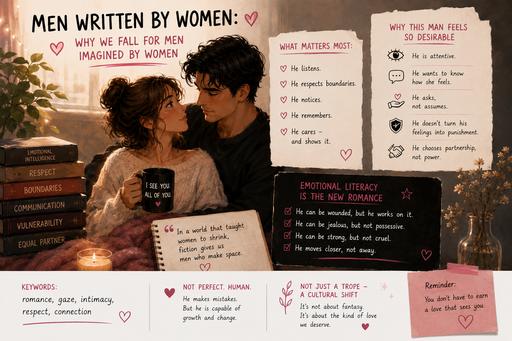
The phenomenon became especially visible through BookTok, romance fiction, and the culture of “book boyfriends,” but its roots go much deeper. It is not only about wanting the perfect man. It is also about being tired of versions of masculinity where strength too often means emotional unavailability, control, or coldness.
What Does “Men Written by Women” Mean?
The phrase men written by women emerged as a response to another cultural cliché: women written by men. The latter usually describes female characters shaped by male fantasy – oversexualized, flat, convenient, and existing in the story more as an object of desire than as a person with her own inner life.
Men written by women works in the opposite direction. This is not a man created only for visual pleasure. This is a man imagined through attention to women’s emotional reality.
He may be beautiful, of course. Romance does not have to pretend that appearance never matters. But his appeal rarely depends only on cheekbones, rolled-up sleeves, or a dramatic look from across the room. What matters most is not how he looks, but how he treats the heroine.
He notices when she is uncomfortable. He remembers what matters to her. He does not confuse persistence with romance. He does not see female strength as a threat. He may be jealous, stubborn, awkward, or hurt, but he does not turn his feelings into punishment for her.
It Is Not a Type of Man, But a Type of Gaze
Importantly, men written by women is not a biological category, nor does it guarantee that every male character written by a woman will fit the ideal. Women can also write toxic, flat, or emotionally immature heroes. Men can also create subtle, tender, and complex male characters.
So it is more accurate to speak not about the author’s gender, but about the gaze. This is a man written not from the position of “how can he be possessed?” but from the position of “what does it feel like to be near him?” His romantic value is measured not by his power over a woman, but by the quality of his presence with her.
From Male Gaze to Female Gaze
To understand the phenomenon, it helps to remember the concept of the male gaze. In classic feminist theory, the term describes a way of representing women as objects of observation, desire, and visual control. The camera, the story, and the viewer’s position are arranged around male pleasure.
The female gaze emerged as a response to this imbalance, but it does not simply mean “now women look at men the same way.” Its meaning is subtler. It is not revenge by reversal, nor an attempt to replace one object with another. The female gaze restores subjectivity: desire, inner experience, the body, fear, pleasure, shame, fantasy, and a woman’s right not only to be seen, but to be heard.
In that sense, men written by women are one of the most visible pop-cultural products of the female gaze. This hero is not merely beautiful to the heroine. He is safe for her desire. With him, she can want without shrinking. She can be sexual without becoming an object. She can be complicated without losing desirability. She can be strong without becoming “too much.”
Why This Man Feels So Desirable
At first glance, it may seem like the whole thing is just romantic idealization. But if we look closer, the “man written by a woman” is rarely perfect in a sterile sense. He does not always say the right thing. He does not always understand himself immediately. Sometimes he makes mistakes, gets defensive, becomes afraid, or retreats into silence. The difference is elsewhere: he is capable of learning intimacy.
His most erotic quality is not dominance, but attentiveness.
In a culture where female desire has long been portrayed as secondary, dangerous, ridiculous, or in need of control, an attentive man becomes an almost radical figure. He does not simply want the heroine. He wants to know what she feels. He does not simply rescue her. He asks whether she needs help. He does not merely suffer beautifully. He tries not to destroy others with his suffering.
Emotional Literacy as the New Romance
In recent romance fiction, the hero’s appeal increasingly depends not on his unavailability, but on his emotional competence. Yes, mystery still works. Yes, slow burn still thrives on tension, pauses, and things left unsaid. But the contemporary desirable hero can no longer be merely cold and complicated. He must be able to move closer.
This does not mean readers want a character without conflict. On the contrary, conflict often makes the story delicious. But audiences increasingly distinguish drama from emotional irresponsibility. A man can be wounded, but trauma should not become a permanent excuse for cruelty. He can be jealous, but jealousy should not cancel consent. He can be strong, but his strength should not require a woman’s silence.
This is why men written by women are so often associated with care. Not sugary, decorative care, but care that reveals itself through action: bringing food when someone has forgotten to eat; noticing exhaustion; refusing to pressure; remembering a detail; stopping when he needs to stop; staying when the conversation becomes uncomfortable.
Why It Became So Popular Now
The rise of men written by women is not accidental. It coincides with several larger cultural shifts.
First, romance fiction is no longer a genre people can dismissively hide behind a discreet cover. Romance, romantasy, and BookTok have made women’s reading visible, loud, and commercially powerful. What used to be discussed in book clubs, fan forums, and private messages now becomes a trend, a meme, and a market force.
Second, the conversation about intimacy has changed. Generations of readers increasingly talk not only about love, but about boundaries, emotional labor, psychological safety, unequal care, and exhaustion from relationships where women become managers of other people’s feelings.
Third, the model of desirable masculinity itself is changing. The traditional image of the “real man” – silent, hard, always in control – increasingly feels less seductive than exhausting. In his place comes another kind of hero: soft but not weak; vulnerable but not helpless; caring but not devoid of desire.
This is not the cancellation of masculinity. It is an attempt to imagine masculinity without emotional poverty.
Is It a Manual for Men?
Yes and no.
If men written by women are taken literally, as a list of gestures, the result is bad theatre. Not every man needs to stand in the rain, deliver a three-page monologue, remember every sentence from the first meeting, or appear precisely when the heroine is looking out the window with a broken heart. Real intimacy rarely looks that cinematic.
But if we understand the phenomenon as a map of values, then yes, it can function as a kind of manual.
Not “how to perform the perfect man,” but “what women increasingly recognize as emotionally mature behavior.”
Listen. Respect refusal. Do not mock feelings. Do not turn conflict into a power struggle. Do not expect a woman to explain, get hurt, forgive, and restore the connection all by herself. Learn how to apologize. Do not be afraid of tenderness. Take an interest in her inner life not only when it leads to romantic or sexual reward.
Not a Script, But a Standard
The problem begins when “the man written by a woman” becomes a performance. When care becomes an aesthetic rather than an ethic. When someone imitates softness without respecting another person’s freedom. When beautiful words replace the real ability to listen.
So this is not a manual in the sense of “do this and you will be loved.” It is more like a reminder: contemporary romantic fantasy has less and less patience for emotional laziness. Being mysterious is no longer enough. Being attractive is no longer enough. To be desirable is to be capable of reciprocity.
Or Is It Just Wishful Thinking?
Of course there is wishful thinking here. Romance as a genre works with desire: it intensifies, clarifies, and dramatizes what reality often lacks. But wishful thinking should not be dismissed. Fantasy is not a trash bin for naivety. It is often the most precise way of seeing what reality is missing.
If millions of readers fall for men who listen, care, admit mistakes, and see women as equals, the question is not why women “want too much.” The question is why those qualities still feel almost fantastical.
Men written by women are a dream, but dreams do not necessarily lie. Sometimes they simply tell the truth in the language of desire.
This hero does not show a perfect reality. He shows emotional justice. A world where female sensitivity is not used against women. Where desire is not punished with shame. Where a man does not need a woman to make herself smaller in order for him to feel strong. Where love is not a test of endurance, but a space of mutual recognition.
The Problem with the Ideal Man
The phenomenon has its weak spots. The main risk is that it can put men back at the center. Even in stories created by women and for women, the conversation sometimes becomes all about how wonderful the hero is: his tenderness, his trauma, his gaze, his lines, his jealousy, his redemption. At some point, the female heroine can become the background for male appeal again.
There is another risk: a new stereotype. If mainstream culture once sold the hard alpha hero, now it sometimes sells the perfect emotional partner. He reads, cooks, goes to therapy, says the right words, loves cats, is not afraid of flowers, and always knows when to hold someone and when to give space. This is more pleasant than the old stereotype, but it is still a stereotype.
A real person cannot be endlessly tuned to someone else’s emotional frequency. Real relationships require not perfect mind-reading, but conversation. Not flawless tenderness, but the ability to repair what has been damaged. Not fantastical intuition, but responsibility.
So the healthy conclusion is not that a man must be like a romance hero. It is that a real man should not use “reality” as an excuse for cruelty, coldness, or disrespect.
What Are Men Written by Women For?
These characters do not exist so women can give up on real men entirely. Nor do they exist so men can receive a job description disguised as a romantic fantasy.
They exist to expand the imagination.
Culture has long offered women a compromise: if you want passion, tolerate danger; if you want a strong man, accept control; if you want love, be convenient; if you want to be desired, do not be too complicated. Men written by women offer a different fantasy: passion without humiliation, strength without violence, tenderness without weakness, intimacy without self-erasure.
That is why the trope is so compelling. It is not only about men. It is about women who are tired of treating minimal attentiveness as luxury. About readers who want desire to be intelligent and care to be sexy. About a culture in which romantic fantasy becomes not an escape from reality, but a way of making a claim against it.
Ultimately, men written by women are not men who exist only in books. They are men culture still too rarely knows how to represent, recognize, and encourage.
And perhaps the main question is not whether they are real. It is why we agreed to settle for less for so long.
FAQ
Q: What does “men written by women” mean?
A: It is a cultural term for male characters written through the female gaze, with an emphasis on respect, emotional maturity, attentiveness, care, and the ability to see a woman as a full subject rather than an object of desire or a plot function.
Q: Is it the same as “the perfect man”?
A: Not exactly. “Men written by women” are often idealized, but their appeal usually comes not from perfection, but from emotional reciprocity. They can be flawed and complicated, but they are capable of listening, changing, and taking responsibility.
Q: Is this a manual for men?
A: Not literally. It is not a list of romantic gestures to copy. But as a map of values, yes. The phenomenon shows that more and more women find respect, consent, emotional literacy, care, and the ability to communicate deeply attractive.
Q: Is it just fantasy?
A: Yes, but fantasy does not mean emptiness. It reveals what people lack in reality. The popularity of “men written by women” says less about readers being naive and more about a cultural desire for a more mature, tender, and reciprocal model of love.
Q: Why is this trope so popular in romance and romantasy?
A: Because these genres are built around emotional satisfaction. They create a space where female desire is taken seriously and love becomes not punishment or compromise, but a form of recognition, safety, and joy.