
The Slow Burn Spell: Why We Love Romance That Takes Its Time
Slow burn is one of the most beloved tropes in modern romance and for good reason. It is built on tension, anticipation, emotional restraint, and the delicious feeling that something is happening long before anyone dares to say it out loud.
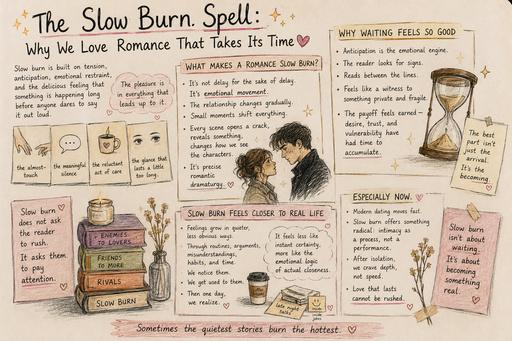
At first glance, a slow burn romance may seem like a story where “nothing happens” for a very long time. But that is exactly where its power lies. The pleasure is not only in the kiss, the confession, or the moment the characters finally get together. It is in everything that leads up to it: the almost-touch, the meaningful silence, the reluctant act of care, the glance that lasts a little too long.
Slow burn does not ask the reader to rush. It asks them to pay attention.
What Makes a Romance Slow Burn?
A slow burn romance is not simply a love story where the characters take a long time to kiss. The best slow burns are not built on delay for the sake of delay. They are built on emotional movement.
The characters may start as rivals, colleagues, friends, strangers, or people who deeply misunderstand each other. What matters is that their relationship changes gradually. They notice new things. They revise their first impressions. They become softer, more curious, more vulnerable, sometimes unwillingly.
In a good slow burn, every scene shifts something. A conversation opens a crack in someone’s defenses. A small gesture reveals more than a grand declaration could. A character who once seemed cold becomes readable. A person who was easy to dismiss becomes impossible to ignore.
That is why slow burn is not a slow plot. It is precise romantic dramaturgy.
Why Waiting Feels So Good
The emotional engine of slow burn is anticipation. Readers often know – or at least hope – that the characters will eventually find their way to each other. But instead of weakening the experience, that expectation makes it more intense.
The reader begins to look for signs. Is this jealousy? Is this tenderness? Did they mean to say that? Did they just realize something? Are they still pretending not to care?
Slow burn turns romance into a game of emotional recognition. The audience is invited to read between the lines, to catch the shift before the characters themselves are ready to name it. That kind of reading is intimate. It makes the reader feel like a witness to something private and fragile.
And when the payoff finally comes, it feels earned. Not because the story withheld pleasure, but because it allowed desire, trust, and vulnerability to accumulate.
Slow Burn Feels Closer to Real Life
Stories where two people meet, instantly understand they are meant to be together, and never seriously doubt it can be beautiful. But they are not always how intimacy works in real life.
More often, feelings grow in quieter, less obvious ways. We meet people through work, friendship, shared routines, arguments, misunderstandings, or even irritation. We get used to their voice, their habits, their way of looking at the world. We see how they behave when they are tired, disappointed, afraid, generous, or unguarded. And sometimes, only later, we realize that something has been growing all along.
This is part of what makes slow burn so satisfying. It feels less like a fantasy of instant certainty and more like the emotional logic of actual closeness. Love does not arrive fully formed. It develops through attention.
That may also be why the trope feels especially resonant now. Modern dating culture often moves quickly: fast matches, fast conversations, fast intimacy, fast disappointment. People can meet, flirt, exhaust the connection, and disappear before they have truly learned each other. Against that backdrop, slow burn offers something almost radical: the idea that intimacy is not a performance or a spark to be consumed, but a process.
After the pandemic and the experience of isolation, many readers also seem more drawn to stories that promise depth rather than speed. Not just entertainment, not just chemistry, but love that feels emotionally grounded. And that kind of love cannot be rushed.
Slow Burn in Contemporary Romance
One reason slow burn works so well in popular fiction is that it can slip into almost any romantic setup. It does not belong to one genre, one type of couple, or one kind of story. Instead, it changes shape depending on the emotional obstacle between the characters.
In an enemies-to-lovers story, slow burn gives hostility time to become curiosity. The characters may begin by challenging each other, competing, arguing, or assuming the worst. But the longer they are forced to pay attention, the harder it becomes to reduce the other person to an enemy. Irritation turns into fascination; rivalry becomes chemistry; conflict reveals vulnerability.
In a workplace romance, slow burn often grows through routine. Two people may see each other every day, exchange sharp comments, collaborate under pressure, or pretend their attention is purely professional. The tension comes from repetition: the same desk, the same meetings, the same small rituals — until familiarity begins to feel dangerously intimate.
In a fake dating story, slow burn thrives on the gap between performance and feeling. The characters may agree to pretend they are together for practical reasons, but the act of performing affection slowly becomes harder to separate from the real thing. A staged touch lingers too long. A rehearsed compliment sounds too honest. The relationship begins as a fiction, but the emotions refuse to stay fake.
In a friends-to-lovers arc, slow burn is built on recognition. The characters may already know each other deeply, but the romance begins when familiar tenderness shifts into something more charged. The pleasure lies in watching them reinterpret what was always there: the loyalty, the protectiveness, the comfort, the fear of risking everything by naming desire.
In forced proximity, slow burn uses closeness as pressure. When characters are trapped in the same space, journey, project, or crisis, they cannot easily escape each other’s habits, flaws, or softer sides. Proximity strips away performance. Over time, annoyance becomes understanding, and understanding becomes attachment.
In romantasy, slow burn can take on an even larger emotional scale. The romantic arc may be tied to danger, healing, power, self-discovery, or trust. Love is not simply a reward at the end of the plot; it becomes part of the character’s transformation. The relationship matters because it helps someone become freer, braver, or more fully themselves.
These setups may be very different in tone and genre, but they all reveal the same essential truth: slow burn is not about keeping characters apart for as long as possible. It is about making their eventual closeness feel inevitable, meaningful, and earned.
Why Slow Burn Works So Well with Other Tropes
Slow burn rarely exists alone. It often strengthens other beloved romance tropes: enemies to lovers, friends to lovers, fake dating, forced proximity, workplace romance, second chance romance.
In enemies to lovers, slow burn gives the characters time to stop seeing each other only as opponents. In friends to lovers, it allows familiar tenderness to become charged with new meaning. In fake dating, it creates dramatic irony: everyone else sees a couple before the characters are ready to admit they might be one. In forced proximity, it keeps people close long enough for their masks to slip.
That is why slow burn is so emotionally effective. It does not only ask, “Will they get together?” It asks a better question: “What has to change before they can finally choose each other?”
The Difference Between Slow Burn and Stagnation
A weak slow burn can feel frustrating. If the characters keep circling the same conflict without growing, if misunderstandings are stretched too thin, or if the delay feels artificial, the story loses tension.
A strong slow burn, however, is never static. Even when the characters are not physically together, something inside the relationship is developing. Trust deepens. Defenses weaken. Desire becomes harder to deny. The emotional stakes rise.
The key ingredients are chemistry, believable obstacles, and visible progress. Chemistry gives the reader a reason to care. Obstacles make the delay meaningful. Progress keeps the story alive.
Slow burn needs restraint, but it also needs movement. The flame can be low, but it still has to burn.
Why We Still Need Slow Love
In a culture obsessed with speed, slow burn offers the luxury of attention. It invites readers to linger. To notice. To enjoy the almost, the not-yet, the maybe.
There is comfort in stories where love is allowed to take time. They suggest that intimacy does not have to be instant to be powerful. That desire can grow from trust. That understanding someone may be as romantic as wanting them. That the most meaningful relationships are not always the ones that begin with certainty, but the ones that become undeniable.
Perhaps that is why slow burn remains so popular across contemporary romance, fanfiction, rom-coms, and romantasy. It gives readers the emotional pleasure of watching love become inevitable, not because fate says so, but because the characters have slowly, stubbornly, beautifully earned it.
Sometimes the most romantic moment is not the first kiss.
Sometimes it is the moment one person realizes the other has already become important.
And by then, the fire has been burning for a long time.
FAQ
Q: Does slow burn mean a romance without sex scenes?
A: No. Slow burn does not mean the absence of sexuality. It means that emotional or physical intimacy develops gradually, and the tension builds toward a meaningful moment.
Q: How is slow burn different from a regular romantic subplot?
A: In a regular romantic subplot, the relationship may be only one part of the story. In slow burn, gradual emotional closeness becomes the main source of pleasure and tension.