
Title Where Is the Book Market Heading in 2026? Key Trends in Audiobooks, Romance, and Digital Reading
Meta Description Explore where the digital book market is heading in 2026. Discover key trends in audiobooks, serialized storytelling, romance, and platform-driven reading behavior.
H2 Structure (for Table of Contents)
- The Current Market Landscape
- Why This Shift Is Happening
- Audience Psychology
- Business and Monetization
- Strategic Implications
- What Comes Next
Tags
Genres: Romance, Romantasy, Contemporary Romance, Digital Literature, Audiobooks
Tropes: Enemies to Lovers, Slow Burn, Emotional Healing, Forbidden Love, Forced Proximity
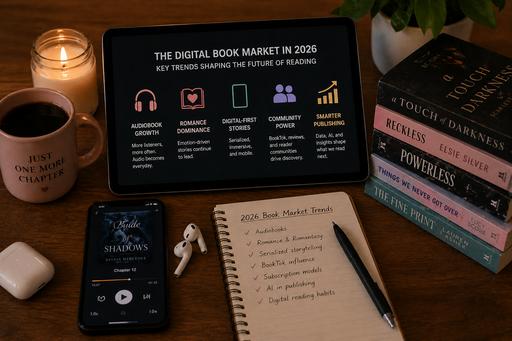
Industry / Trends: Audiobook Trends, Serialized Storytelling, BookTok, Digital Reading, Subscription Economy, AI in Publishing
н1 Where Is the Book Market Heading? The Trends Reshaping Reading, Audio, and Digital Storytelling in 2026
The digital book market is no longer about reading in its traditional sense. It is about how stories weave themselves into everyday life – between commutes, workouts, and endless scrolling.
Over the past few years, books have quietly changed their form. They have become something you listen to, something that unfolds in episodes, something you discuss in comment sections. Stories are no longer static – they are experienced.
Which raises a deeper question: is a book still a book, or has it become something else entirely?
Where is the book market heading?
The market is moving toward a model where stories are no longer single products, but continuous experiences – flexible, emotional, and deeply integrated into digital life.
н2 The Current Market Landscape
The growth of audiobooks and digital reading hasn’t been explosive in a disruptive sense – it has been almost inevitable. People are not consciously “switching” to audio, they are simply choosing what fits their lives better.
What is the modern book market?
The modern book market is not just an industry – it is an ecosystem of story consumption, where format matters less than engagement.
Platforms have adapted to this shift. They are no longer selling books, they are competing for attention. And in this new reality, success is not defined by literary value alone, but by something more immediate: does the user want to keep going?
Readers have changed too. They no longer step out of their lives to read – they bring stories into their lives. Books now exist alongside everything else.
н2 Why This Shift Is Happening
Because the user has changed. Today’s audience is less willing to work for content, but more eager to feel something.
Audio fits perfectly into this dynamic. It doesn’t demand attention, it blends into daily routines.
Subscription models amplify this behavior. When access becomes unlimited, the idea of choosing one book disappears. Users explore, abandon, return, and continue – consuming more without friction.
At the same time, social media has redefined discovery. Books are no longer found–they are felt through other people’s reactions.
н2 Audience Psychology
What do modern readers actually want?
They don’t want content. They want emotional experience.
This is why genres like romance and romantasy continue to dominate. They offer something predictable in structure but powerful in feeling.
What’s changing is not just what people read, but how they engage. Stories are no longer consumed once. They are revisited, extended, and lived in.
This is where serialization emerges – not as a format, but as a behavior. Stories don’t end anymore. They pause.
н2 Business and Monetization
How does the industry make money now?
Not from books, but from user time and attention.
Subscriptions are the foundation, but they are only the beginning. Platforms are now designed to extend engagement for as long as possible.
Serialized content plays a central role here. Each new episode becomes a reason to return, turning storytelling into habit.
At the same time, immersive audio is redefining expectations. Stories are becoming closer to cinematic experiences – without visuals, but with atmosphere, performance, and emotion.
The rise of AI introduces a tension. It makes production faster and cheaper, but in emotionally driven genres, especially romance, audiences still recognize and prefer human nuance.
н2 Strategic Implications
The market is becoming more honest and faster at revealing what works.
Publishers can no longer rely solely on traditional models. They must think in formats, speed, and adaptability.
Platforms are evolving into ecosystems. Their role is not just to provide access, but to keep users inside.
For creators, this is both an opportunity and a challenge. Barriers to entry are lower, but expectations are higher. It is no longer enough to tell a story. It has to be felt.
н2 What Comes Next
More flexibility. Fewer boundaries. Deeper emotional integration.
Audio will continue to grow, but its form will evolve. Shorter formats, serialized narratives, and hybrid storytelling will become more common.
Romance and romantasy will remain central, not by accident, but because they deliver what the market increasingly demands: emotional engagement.
Most importantly, books will fully transition from products to processes – something users return to, rather than finish.
The future of books is not about format. It is about feeling. Stories no longer sit on shelves. They move with people. They play in headphones, surface in feeds, and linger longer than expected. And in this new reality, success belongs not to those who produce more, but to those who understand what their audience wants to feel.