
Fated Mates and the Brain That’s Tired of Guessing: Why Romance Tropes Give Us More Than Plot
Recently, in our social media posts, we shared a thought that sounds like a joke – until you start recognizing yourself in it:
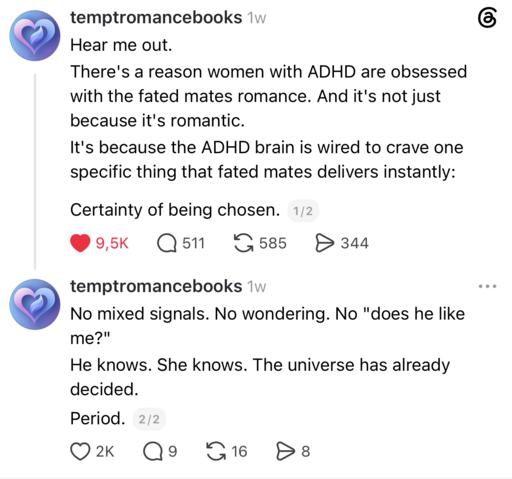
Fated mates is not just “they were destined for each other.” It is a fantasy of a world where you have already been chosen.
No mixed signals. No anxious rereading of messages. No “he replied with a period, is that bad?” No inner jury convening at three in the morning to decide: “Does he like me, or was I just conveniently standing near the plot?”
And if we look wider, many romance tropes work in a similar way. They do not simply offer the reader a familiar scenario. They remove a specific kind of tension.
Why choose removes FOMO.
BDSM tropes offer structure, rules, and clear roles.
Billionaire romance temporarily cancels logistical anxiety.
Fated mates says: you are not an accident. You are a choice that has already happened.
It sounds like a meme. But as is often the case with memes, there is an entire cultural machine under the hood.
First, an Important Note: Your Bookshelf Cannot Diagnose You
No, we are not claiming that everyone with ADHD loves fated mates. Or that a love of billionaire romance is a symptom. Or that you can build someone’s psychological profile from their favorite tropes like a natal chart for Kindle.
You cannot.
But we can do something else: look at why certain tropes may feel especially resonant for people familiar with overwhelm, decision fatigue, uncertainty, struggles with self-regulation, and the constant sense that life has too many tabs open.
ADHD is a neurodevelopmental disorder that can involve difficulties with attention, impulsivity, organization, task completion, and time management; in adults, these traits can look different than they do in children.
That is why the conversation about romance tropes and ADHD is interesting not as “proof of taste,” but as a lens. Not a medical one. A cultural one. A readerly one.
Because romance fiction has long been doing something it is unfairly underestimated for: it works with extraordinary precision around human needs for safety, intimacy, choice, recognition, and emotional resolution.
Romance Is Not Just Predictable. It Is Honest.
Romance fiction is often condescendingly called “formulaic,” as if a formula were automatically a weakness. But in romance, the formula is not hidden. It is the contract with the reader.
In the classic definition of the genre, a romance novel is built around a central love story and must arrive at an emotionally satisfying, optimistic ending.
In other words, romance tells the reader upfront: yes, it will hurt, it will be awkward, intense, funny, anxious, and sometimes very dramatic. But in the end, the world will not fall apart. Feelings will not be punishment. Love will not be merely a coming-of-age episode after which the heroine is expected to become wiser and lonelier. Here, love is not a trap. Here, it can be a place of return.
In that sense, the predictability of romance is not a flaw. It is part of the pleasure.
We do not read because we do not know whether they will end up together. Most of the time, we know exactly that. We read to find out how they will get there. Through hatred, fake dating, one bed in a hotel room, a magical bond, a contract, an inheritance, a space war, or a deeply inconvenient corporate retreat.
Romance does not ask: “What if love does not exist?”
It asks: “What needs to happen for these people to finally allow themselves to be loved?”
And that is an entirely different level of conversation.
A Trope Is Not a Cliché. It Is an Emotional Promise.
Romance tropes are often treated like a set of labels: enemies to lovers, fake dating, forced proximity, second chance, grumpy/sunshine, fated mates. But in contemporary reading culture, a trope is not merely a recurring plot element. It is a way of navigating.
Scholars of popular romance describe a trope as a recognizable narrative device or characteristic that sets expectations about the direction of the story and the characters’ dynamic; tropes also function as tags used to market, catalogue, and recommend books.
Put simply, a trope is a promise.
Enemies to lovers promises tension, resistance, and the moment when “I cannot stand you” turns into “I know you too well to keep pretending.”
Fake dating promises a game between performance and truth: they are supposedly pretending, but then why does the jealousy feel real?
Forced proximity promises closeness that cannot be escaped: one room, one mission, one snowstorm, one plot god who has locked all the exits.
Fated mates promises absolute certainty: the bond already exists, even if the characters are still resisting it.
Tropes give the reader not only a plot, but a nervous-system setting. They announce: this is the kind of pleasure waiting for you. This is where the tension will be. This is where the release will come. This is what you will not have to fear.
For any reader, that is convenient. For a reader who often lives in overwhelm, it can feel especially magnetic.
ADHD, Reading, and the Pleasure of Predictability
People with ADHD do not “read badly.” That is an important clarification. Many read a lot, passionately, obsessively, in hyperfocus – so intensely that “one more chapter” turns into dawn, an empty water bottle, and sudden knowledge of the entire genealogy of every werewolf in the series.
But the process of entering a text can differ. Sometimes it is hard to start. Sometimes it is hard to sustain attention. Sometimes the brain wants a strong emotional hook immediately. Sometimes it needs to understand why it should spend energy right now.
Research on reading and ADHD shows that much depends on the specific task: in some studies, people with ADHD find it more difficult to identify central ideas in a story or retell the content, while they may perform successfully on other types of questions.
There is another important line here: motivation. Studies of reading among children with ADHD highlight the role of interest, choice, reward, and the reading experience itself.
And this is where tropes become more than marketing tags. They function as an entry point.
A trope says: “You do not have to push through fifty pages just to understand what kind of experience this will be. Here is the emotional map. Here is the route. Here is the type of pleasure.”
For a brain tired of uncertainty, that may not feel like simplification. It may feel like care.
Fated Mates: The Fantasy of Having Already Been Chosen
Let’s begin with the main character of our post: fated mates.
On the surface, it is a trope about destiny. There are many variations: a magical bond, a true mate, predestination, a mark, a scent, an ancient prophecy, supernatural recognition. Sometimes it is fantasy. Sometimes paranormal romance. Sometimes simply a very dramatic way of saying: “You are my person.”
But the emotional core of the trope is much deeper. Fated mates removes the central question of romantic uncertainty:
“Does he even want me?”
In ordinary life, that question rarely disappears instantly. People reply in the wrong tone. They look too long or not long enough. They vanish. They return. They write “haha” when what you wanted was “I missed you.” They date us but refuse to call it a relationship. They call it a relationship but behave like a seasonal character.
Fated mates cancels the torture of interpretation.
He knows. She knows. The world knows. Even if the characters argue, deny it, run into the forest, fly to another planet, or make a deeply unconvincing deal with themselves that “I am only protecting her, it means nothing,” the reader already understands: the bond is there.
And that is the main pleasure.
Fated mates is not only the romance of inevitability. It is a fantasy of love without a constant exam in being easy to love. A fantasy of love where you are chosen not because you answered on time, understood the hint correctly, were not “too much,” remembered the important date, or managed not to ruin the moment with your anxiety. You were chosen before you had time to become perfect.
For people with ADHD, relationships can be an especially sensitive area: in a qualitative study of adults with ADHD, participants described how ADHD symptoms could complicate romantic relationships, and some experiences were connected to feeling like a “burden” to a partner.
That may be why fated mates can land so precisely. It offers a world where the question “Am I too complicated?” loses its power. Not because the heroine suddenly becomes simple. But because love in this world does not require her to disappear in order to be accepted.
Why Choose: When Love Does Not Require the Amputation of Possibility
Why choose is often described too flatly: “a romance where the heroine does not choose one partner.” But emotionally, this trope does something more interesting.
It asks: what if choice does not always have to mean loss?
In a culture that constantly teaches us to optimize decisions, choose the “best option,” avoid mistakes, avoid missing out, avoid regret, the act of choosing itself can become exhausting. Especially when every option carries not only pleasure, but also the loss of all the other options.
Why choose does something radical: it removes scarcity from the equation of love.
Not “who will she choose?”
But “what if love could be structured differently?”
Of course, in real life, any relationship requires agreements, maturity, boundaries, and honesty. Romance does not have to be a life manual. It is rarely at its best when read as one. But as a fantasy, why choose offers freedom from one very familiar anxiety: “What if I choose wrong?”
In this trope, love does not look like a corridor with one door, after which all the others close forever. It looks like a space where desire is not automatically punished for existing.
For a reader with ADHD, who may know the feeling of “I want everything, all at once, in different ways, and I am also afraid I will regret it,” this can feel less like frivolity and more like relief.
Why choose is not necessarily a fantasy of “having everyone.” Sometimes it is a fantasy of not turning your own heart into a spreadsheet of pros, cons, and anxious five-year forecasts.
And yes, sometimes it is simply very fun. Literature is allowed to be fun. Especially romance.
BDSM Tropes: The Fantasy of Rules That Are Finally Clear
BDSM tropes require careful language. Not because the topic is forbidden, but because it is easy to flatten into cliché.
In strong romance writing, BDSM is not “a dark man likes giving orders.” At its best, it is a story about negotiation, trust, boundaries, consent, roles, rituals, and clearly articulated rules. In other words, the very things ordinary romantic communication often lacks catastrophically.
And this is where the connection with ADHD becomes interesting.
In everyday life, structure often requires internal resources: remembering, planning, regulating yourself, explaining yourself, holding in your head what was said, what was implied, and what needs to happen next. For someone who already struggles with organization, time management, or task maintenance, this can become an exhausting background hum.
A BDSM trope in romance offers a fantasy in which structure is externalized.
The rules are named.
The boundaries are discussed.
The roles are clear.
The scene has a beginning and an end.
Desire is not guessed at – it is communicated.
And that may be the most compelling part: not control as suppression, but control as clarity. Not power for the sake of power, but a form within which one can stop constant self-monitoring.
In that sense, a BDSM trope may work almost opposite to how it is sometimes caricatured. It is not necessarily about “someone deciding for me.” It can be about “finally, everyone has said out loud what they want.”
Which, let’s be honest, is almost utopian.
Billionaire Romance: The Fantasy of Life Without Logistical Anxiety
Billionaire romance is often criticized for being unrealistic. This is a funny complaint about a genre where a billionaire can simultaneously run a corporation, have abs that function as a separate architectural structure, fly private, remember the heroine’s favorite tea, and become emotionally available after one serious scene by a window.
Of course it is unrealistic. That is the point.
But billionaire romance does not sell only wealth. It sells the disappearance of logistics.
In this fantasy, you do not have to think about how to get home safely at night. You do not have to choose the cheapest flight with a connection in an inconvenient airport. You do not have to cancel dinner because “this month already included a dentist appointment.” You do not have to hold in your head insurance, rent, deadlines, gifts, taxes, repairs, delivery, doctor’s appointments, the washing machine that suddenly broke, and the guilt of forgetting to buy pet food again.
Billionaire romance says: domestic management is temporarily cancelled.
Get in the car. The suitcase is already packed. The dress is already hanging there. The island has already been bought. Unfortunately, there is also a helicopter.
And this is not necessarily the fantasy of “I want a rich man.” Sometimes it is the fantasy of “I want someone else to deal with the infrastructure of my life for two hundred pages.”
For a reader living in constant administrative exhaustion, such a fantasy can feel surprisingly tender. Not because money itself is romantic. But because the absence of anxiety is romantic. A free evening is romantic. A solved problem is incredibly sexy in the most cultural, metaphorical, and fiscally responsible sense.
Billionaire romance is a fairy tale about resources. And the resource here is not only financial. It is time, attention, protection, the ability not to be the chief operating officer of your own life – at least in your imagination.
Why This Works Beyond ADHD, Too
It is important to be honest: these tropes are not loved only by readers with ADHD.
The need to be chosen is universal.
Decision fatigue is universal.
The desire for clear rules is universal.
The dream of life without logistical hell is so universal it could be placed on the coat of arms of contemporary adulthood.
ADHD does not create these desires from nothing. It may make some of them louder, sharper, more embodied. Where one reader sees simply a “romantic convention,” another may feel: “Oh. This is exactly the part of life I am tired of.”
And there is nothing shameful about that.
Reading romance does not mean being naive. It does not mean “not understanding real life.” Often it means precisely the opposite: because the reader understands real life very well, they need a genre where at least part of the pain is transformed into form, rhythm, and promise.
We do not read fated mates because we believe there is one magically assigned person in the world who will never ask us to “send location” instead of offering actual emotional participation.
We read it because it is pleasant to imagine a world where love does not begin with uncertainty.
We do not read billionaire romance because we seriously believe a private jet is the foundation of healthy attachment.
We read it because sometimes we want the journey from point A to point B not to require three apps, two transfers, and moral preparation.
We do not read BDSM tropes because everyone urgently needs rules in the bedroom.
We read them because clarity of desire is a rare luxury.
Digital Culture Has Only Intensified This
Social media has turned tropes into a language. Today, a reader does not always say: “I want a novel about the gradual emergence of trust between two emotionally closed-off people who are forced to spend time together under conditions of heightened vulnerability.”
They say: forced proximity, slow burn, grumpy/sunshine.
And everyone understands.
Tropes have become shorthand for emotional needs. A quick way of saying: “I need tension, but safe tension.” “I need jealousy, but with payoff.” “I need him to be cold to everyone but her.” “I need the world to stop being ambiguous, at least here.”
This does not impoverish reading. On the contrary, it makes visible what has always been present in the genre: people choose books not only by plot. They choose emotional temperature.
Someone needs chaos today.
Someone needs tenderness.
Someone needs a high level of dramatic growling against a wall.
Someone needs the heroine to finally be chosen without a competition, an interview, and a probation period.
And romance replies: we have a shelf for every state.
So Why Does It Hit So Hard?
Because romance fiction knows how to do something mainstream culture often devalues: it takes the desire to be loved seriously.
Not as weakness.
Not as a teenage phase.
Not as something an “intelligent woman” should outgrow.
But as one of the central human experiences.
Romance says: wanting intimacy is normal. Wanting clarity is normal. Wanting to be chosen is normal. Wanting a break from decisions, money, anxiety, domestic life, and the endless need to be composed is also normal.
And if certain tropes happen to resonate especially strongly with the ADHD experience, perhaps it is not because they were “made for ADHD.” Perhaps they simply touch, with great precision, the places where modern people are tired.
Fated mates produces certainty.
Why choose produces abundance without loss.
BDSM tropes produce structure and explicit communication.
Billionaire romance produces liberation from logistics.
This is not therapy. Not a diagnosis. Not a scientific formula for readerly taste.
But it is a useful reminder: sometimes a “favorite trope” is not just a favorite trope. Sometimes it is a small emotional technology. A way to spend a little while in a world where the most painful question has already been answered.
He knows.
She knows.
The universe has decided.
And for a few hundred pages, that is enough.