
Why We Crave the Villain: The Mainstreaming of Dark Romance
Dark romance has long lived on the edge of the book market: too dark for classic romance, too sensual for thriller, too emotional for horror. But that hybrid quality is exactly what has made the genre so addictive. In 2026, dark romance is increasingly moving out of its niche “guilty pleasure” status and becoming one of the most talked-about languages of contemporary romantic fiction.
Readers do not come to it only for shock value, taboo themes, or “bad boys.” More often, they come for intensity. For the feeling that a story is not afraid to go where love becomes not neat, but dangerous; not comfortable, but all-consuming; not ideal, but morally complicated.
And perhaps that is exactly why we keep returning to the villain.
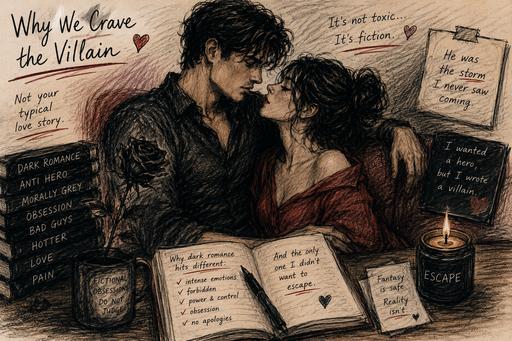
Dark Romance Is Going Mainstream
Dark romance is no longer hiding in the shadowy corners of online catalogs. Its aesthetic – gothic, tense, sensual, slightly dangerous – has become part of the visual and emotional language of BookTok, Bookstagram, and reader communities.
What used to be seen as “not for everyone” is now often at the center of trends: morally grey love interests, enemies-to-lovers, mafia romance, stalker romance, gothic romantasy, horror romance, dark academia, forbidden desire. These no longer feel like marginal subgenres. They have become a full map of reader desire.
And it is not only because of algorithms. Social media certainly accelerates virality: one emotional review, one quotable Reel, one line like “he would burn the world for her” – and a book turns into a collective experience. But the real power of dark romance runs deeper. It speaks to readers in the language of emotions that rarely fit into the “healthy,” edited, socially approved version of love.
What “Maximalism” Means in Romance
One of the key trends surrounding dark romance is romantic maximalism.
This does not simply mean “more drama.” It means wanting stories where everything is pushed to the limit: feelings, stakes, jealousy, danger, attachment, fear of loss, obsession, power, vulnerability. Where conventional romance often offers gradual emotional closeness, dark romance tends to choose an emotional electric shock.
Maximalism in romantic fiction works as a response to an overly polished everyday life. We live in a culture of self-control: be mindful, do not text first, set boundaries, choose safety, do not be dramatic. All of that matters in real life. But fiction does not exist to be a behavioral manual. It exists to create a safe space for emotional speeding.
Dark romance allows the reader to enter a room where feelings are too big, characters are too dangerous, desires are too forbidden, and consequences are fictional. That is the paradox of the genre: the darker the story, the clearer the boundary between fantasy and reality can feel.
Why We Crave the Villain
The villain in dark romance is rarely compelling simply because he is “bad.” His appeal is built on the tension between threat and exception.
He is dangerous to the world, but not to her.
He is ruthless with his enemies, but obsessively attentive to the heroine.
He breaks the rules, but creates his own code of loyalty.
He does not ask to be good, but sometimes, beside the heroine, he becomes capable of tenderness for the first time.
There is an obvious fantasy of control in this archetype. The reader is not simply encountering danger, but danger that chooses the heroine’s side. It is not so much a fantasy of bad behavior as it is a fantasy of complete, almost mythological chosen-ness: being the only person before whom the monster lowers his weapon.
This is where the morally grey hero becomes such a powerful romantic magnet. He is not sterilely correct. He does not promise convenient love. He often frightens, irritates, and disrupts familiar moral patterns. But in fiction, this can create strong catharsis: if even such a person is capable of love, change, devotion, protection, and vulnerability, then love in this story has an almost alchemical force.
The Appeal of Morally Grey Heroes
A morally grey hero is not necessarily a villain in the purest sense. More often, he is a character who lives in a zone of moral compromise. He may be a criminal, a revenger, a mafia leader, a cursed ruler, a hunter, a monster, an antihero, or simply someone who has survived too much to remain soft.
His appeal rests on three things.
First, competence. He is not confused, helpless, or waiting for permission. He acts. In romantic fantasy, this creates a feeling of strength and protection.
Second, intensity. The morally grey hero does not love “a little.” He chooses, pursues, envies, risks, saves, destroys. In real life, this kind of intensity can be alarming. In a book, it becomes an aesthetic.
Third, transformation. The strongest dark romance does not simply romanticize danger; it shows how love exposes the wound. Beneath cruelty, there is often trauma, fear of intimacy, a need for control, or an inability to trust. And when the story is well written, the reader does not get a justification for violence, but a drama of healing – dark, complex, and not always comfortable.
Dark Romance as Catharsis
People do not read dark romance because they “want toxic relationships.” That explanation is far too flat. It is more accurate to say that readers want to safely experience emotional scenarios that would be unacceptable, dangerous, or destructive in real life.
Good dark romance works like an emotional simulator. It allows the reader to experience fear, power, loss of control, jealousy, dependency, desire, and danger – and then return to reality without real consequences. It is not an instruction manual. It is a controlled burn.
In that sense, dark romance is closer to horror than it may seem. We do not watch horror films because we want to meet a killer in the hallway. We watch them because we want to feel fear within a safe frame. In the same way, dark romance offers an encounter with romantic danger inside a fictional space, where the reader can stop, close the book, reread a scene, or choose another story.
Catharsis comes precisely from this sense of control. The reader enters the darkness voluntarily – and decides how far to go.
Where the Comfort Line Begins
Dark romance comes with an important zone of responsibility: the comfort line.
Because the genre deals with themes of power, violence, obsession, coercion, trauma, stalking, captivity, manipulation, revenge, and non-consensual dynamics, honest tone warnings and content warnings become not a marketing formality, but part of reading ethics.
One reader may be comfortable with mafia aesthetics, but not with scenes of coercion. Another may love enemies-to-lovers, but avoid captivity. A third may be fine with gothic violence, but not want plots involving pregnancy, abuse, or trauma flashbacks. This does not make anyone “too sensitive.” It simply means everyone has their own map of emotional safety.
Dark romance does not have to become softer in order to be acceptable. But it does need to be honest. The healthiest reading culture around the genre is built not on shame, but on clarity: here is what this story contains, here is its tone, here is its level of intensity, here are the possible triggers. The reader then chooses for themselves.
Dark Romance, Dark Romantasy, and the New Genre Blending
One of the most noticeable shifts is the blending of dark romance with other genres. Contemporary romantic fiction is living less and less in clean categories. Dark romance easily merges with fantasy, horror, thriller, comedy, academic aesthetics, crime drama, and psychological suspense.
Dark romantasy moves dangerous love into worlds of curses, fae, monsters, magic, and royal intrigue. Horror romance adds bodily fear, blood, slasher tension, and the feeling of forbidden attraction to the monstrous. Dark rom-com plays with contrast: funny and terrifying, flirtation and murderous chaos, chemistry and absurd moral greyness.
All of this shows that dark romance is not one narrow trope, but an umbrella term for stories where romantic desire collides with darkness. Sometimes that darkness is in the world. Sometimes it is in the hero. Sometimes it is in the relationship dynamic itself.
Tempt Picks: Morally Grey, Enemies-to-Lovers, and No-Safe-Corner Reading Mood
For this Tempt selection, the point is not to present dark romance as one single mood. These books sit on the more intense end of the genre: morally grey love interests, dangerous devotion, captivity dynamics, revenge, secret societies, violence, taboo attraction, and heroines forced to discover how far they can bend before they break.
That is why the tone-warning matters. Dark romance can be seductive, cathartic, and emotionally consuming, but it should never arrive without a map. These picks are for readers who want the shadows clearly labeled before they step inside.
1. Consumed by A.K. Rose
For readers who want their dark romance brutal, possessive, high-stakes, and deeply entangled with revenge. Consumed belongs to a larger series and throws the reader into a world of power, captivity, violence, loyalty, and dangerous devotion. The emotional engine here is not soft love slowly blooming in the dark – it is love as war strategy, survival instinct, and the one reason left to keep fighting.
This is a pick for readers who like extreme forced proximity, morally ruined men, found-family loyalty, and a heroine who becomes central to a much larger battle. The romance is intense, obsessive, and built around characters who have already crossed lines most people would never approach.
Tone warning: very dark content, dubcon/noncon, captivity, forced proximity, drugging, mind control, forced sexual situations, degradation/praise kink, exhibition elements, revenge, graphic violence, and extreme power imbalance.
Reading note: MFM romance; part of a series and should be read in order.
2. Pretty Girls Make Graves by Steffanie Holmes
For readers drawn to gothic academia, secret societies, forbidden desire, and the feeling that every library corridor is hiding a body. Pretty Girls Make Graves is dark academia with teeth: ancient rituals, cruel aristocrats, buried sins, a heroine tired of being obedient, and two dangerous men standing at the heart of a rotten institution.
The attraction here is wrapped in taboo, secrecy, and spiritual tension. One love interest carries the cold menace of privilege and power; the other brings the torment of forbidden vows. Together, they turn the story into a gothic descent where romance, horror, and survival blur.
Tone warning: bullying, past sexual abuse, violence, murder, body horror, gore, cannibalism, age-gap taboo relationship, teacher/priest dynamics, secret society coercion, and intense gothic atmosphere.
Reading note: MMF romance; part of a series and should be read in order.
crime-world obsession, forbidden attraction, or a heroine standing in the middle of the fire and refusing to disappear.
3. Killer by Blake Blessing
For readers who want morally grey to become a genuine moral crisis. Killer asks what happens when love does not simply challenge the heroine’s boundaries, but threatens her entire understanding of who she is. Surrounded by possessive men and pulled deeper into a world of crime, violence, and impossible choices, she has to decide whether keeping her soul clean is even possible anymore.
This is the kind of dark romance where the central question is not “can she love the villain?” but “what if loving him means becoming one?” It is intense, claustrophobic, and built around the collapse of easy categories: hero, villain, victim, accomplice, survivor.
Tone warning: sexual assault themes, kidnapping, violence, rape-related themes, drug use, coercive dynamics, possessive behavior, and moral degradation.
Reading note: MMF romance; part of a series and should be read in order.
4. The Rich One by N.O. One
For readers who like their dark romance messy, glamorous, dangerous, and emotionally unstable in the best fictional way. The Rich One follows a heroine with a double life: part River, part Rose, desired by many, fully known by no one. Her world of escorting, desire, money, heartbreak, and danger begins to burn around her, forcing her to navigate men who want different versions of her and a threat that may destroy the fragile control she has built.
What makes this pick compelling is the heroine’s agency. She is not written as fragile decoration inside a dark world. She is strong, proud, complicated, and already surviving before the romance fully closes in. The appeal lies in the tension between control and chaos: how long can she keep every piece of herself separate before the fire reaches her?
Tone warning: graphic sexual content, morally ambiguous relationships, escorting, danger, emotional manipulation, power imbalance, and highly sensitive material.
Reading note: first book in a six-part series and should be read in order.
Together, these books show how wide the dark romance spectrum can be. Some lean into gothic horror. Some into crime, captivity, and revenge. Some into taboo attraction or the erotic danger of losing control. What unites them is not simply darkness, but intensity: the sense that love is not arriving as comfort, but as a force that exposes every wound, every hunger, and every moral limit.
For Tempt readers, the best way into this shelf is not “start with the darkest book possible.” It is to choose the kind of darkness they actually want: gothic secrets, villain devotion,
So, Why Is Dark Romance Popular?
Because it offers something that more polished stories often lack: emotional risk.
Dark romance allows us to read about love that does not ask to be convenient. It explores fantasies of power and surrender, fear and trust, danger and protection, destruction and healing. It does not always offer the right answers – but it often asks questions that simply do not fit inside more sanitized romance.
What makes the monster beloved?
Where does passion end and control begin?
Why can danger in fiction feel like liberation?
Can someone with a dark past still be capable of real tenderness?
And why does a story about forbidden love sometimes offer more catharsis than the healthiest love story?
Perhaps we crave the villain not because we want evil. Perhaps we crave him because in dark romance, evil stops being abstract. It gets a face, a voice, a wound, a desire – and sometimes, a chance to change.
And the reader gets to approach the edge, look down, and still remain safe.